Click a sun to explore
1

Human-AI Interaction

It started with designing AI agents that genuinely enhance human experiences—sports co-viewing, film appreciation, shopping companions.

2

Value Alignment

To make these agents truly useful, I realized they need to embody the right values. What should AI prioritize? How do we prevent sycophancy and ensure genuine deliberation?

3

Fairness & Bias

And what problems must we avoid? I found that multimodal AI systems harbor subtle biases—in hiring, in evaluation, across cultures. Avoiding these is essential for human-centered design.

4

Simulation

Can we simulate human-like agents at scale to test alignment and bias? And when simulation meets HAI, can we build AI systems that truly understand people?

Human-AI Interaction

8 papers

How can AI agents become meaningful partners in everyday experiences? My work designs and evaluates AI companions for sports co-viewing, film appreciation, shopping, and conversational search—exploring what makes human-AI collaboration feel natural, engaging, and socially enriching.
CHI 2026

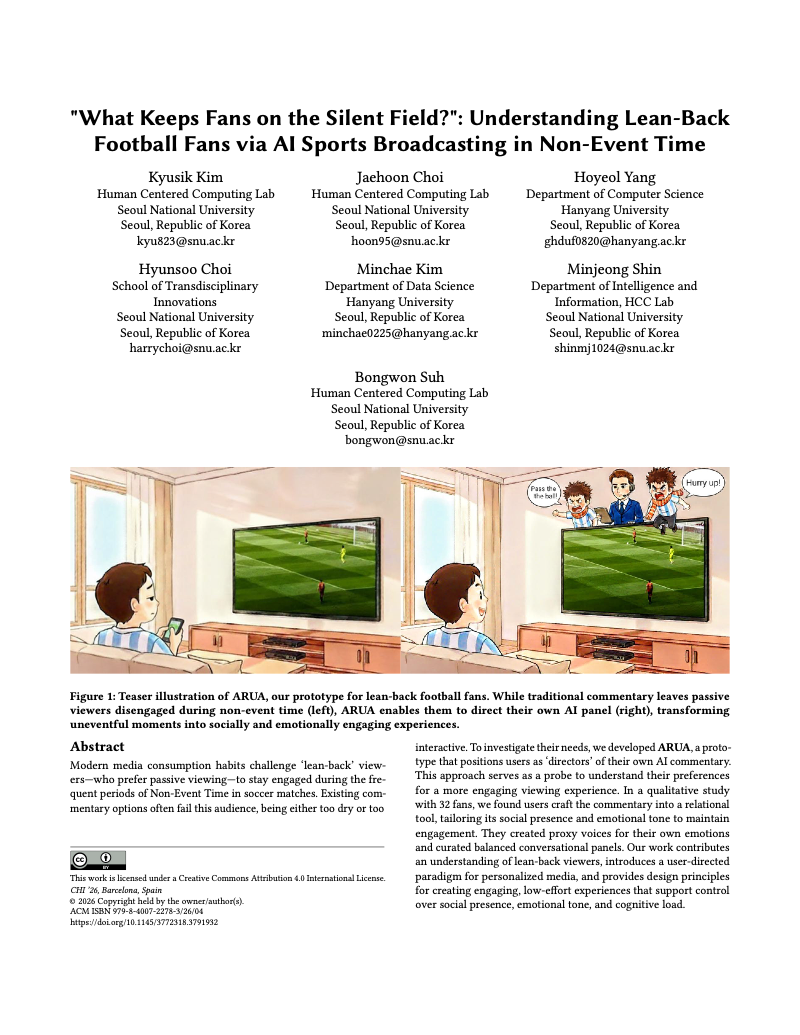
"What Keeps Fans on the Silent Field?"

AI sports broadcasting prototype (ARUA) that lets users direct their own AI commentary, tailoring social presence and emotional tone.
SIGIR 2026

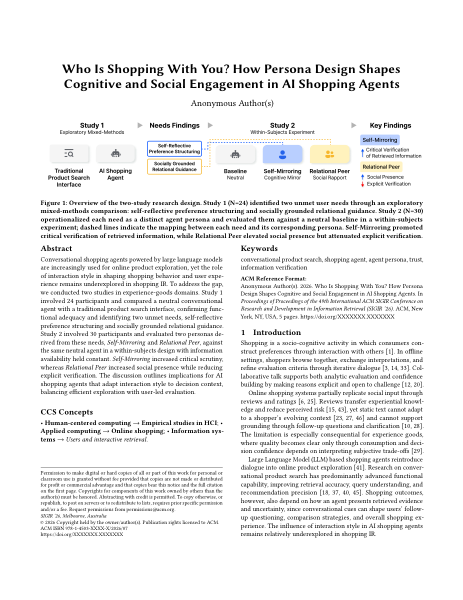
Who Is Shopping With You?

How persona design shapes cognitive and social engagement when AI agents accompany users during shopping.
CogSci 2026

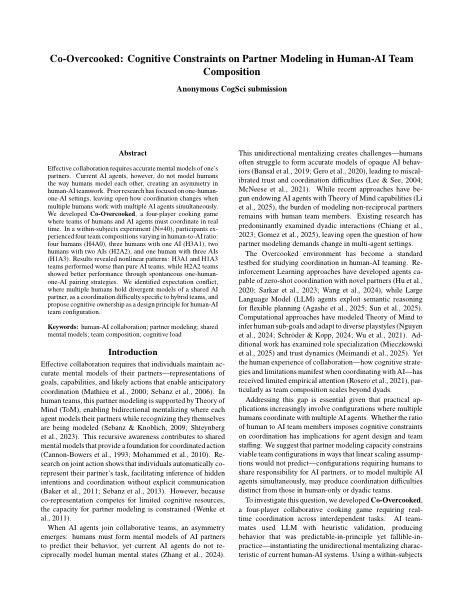
Co-Overcooked: Human-AI Team Composition

Partner modeling capacity constrains viable human-AI team configurations nonlinearly, revealing expectation conflicts when multiple humans model a shared AI partner.
CHI 2025

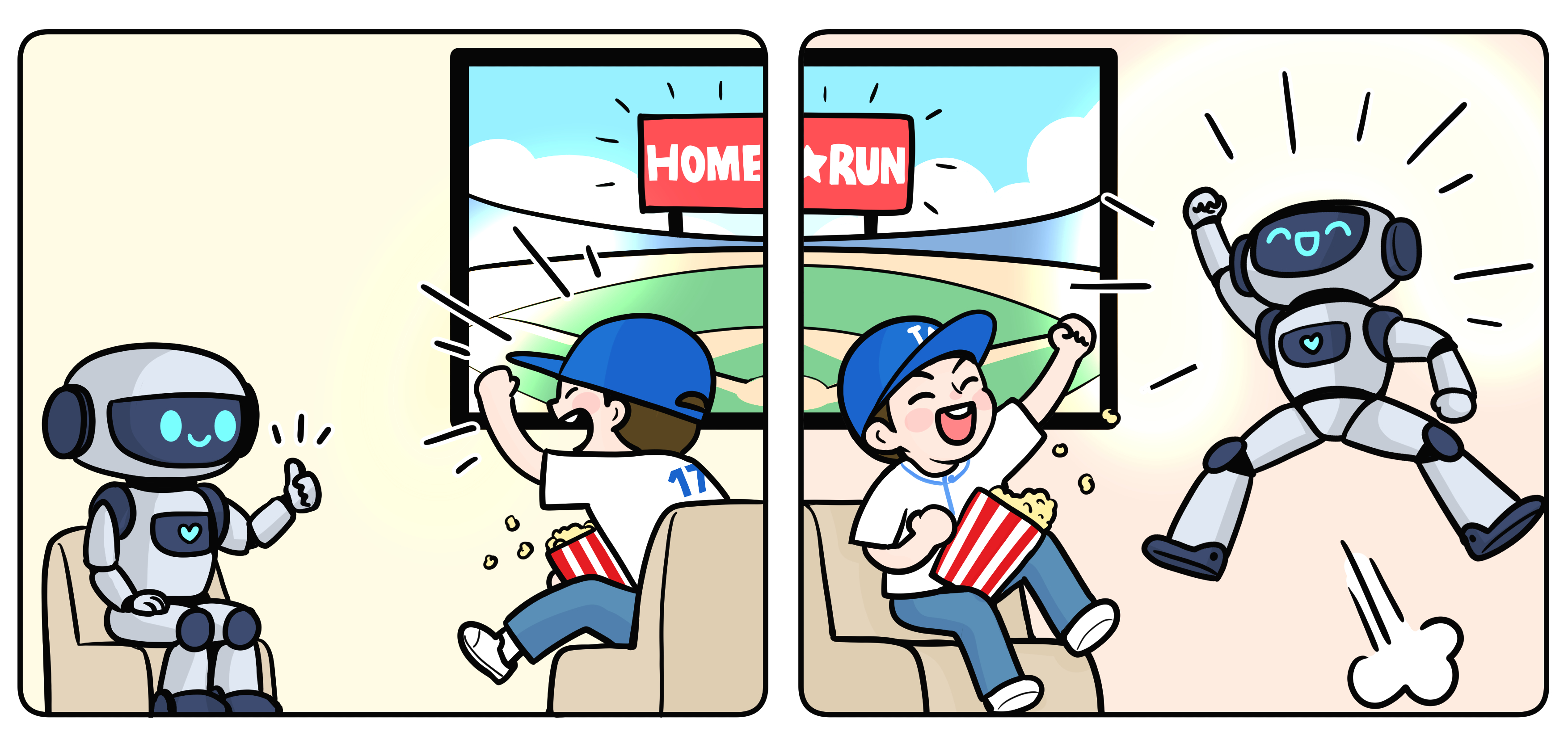
BleacherBot: AI Sports Co-Viewing Partner

Fine-tuned LLM-based AI agent that enhances emotional engagement during baseball co-viewing through context-aware commentary.
CHI 2025

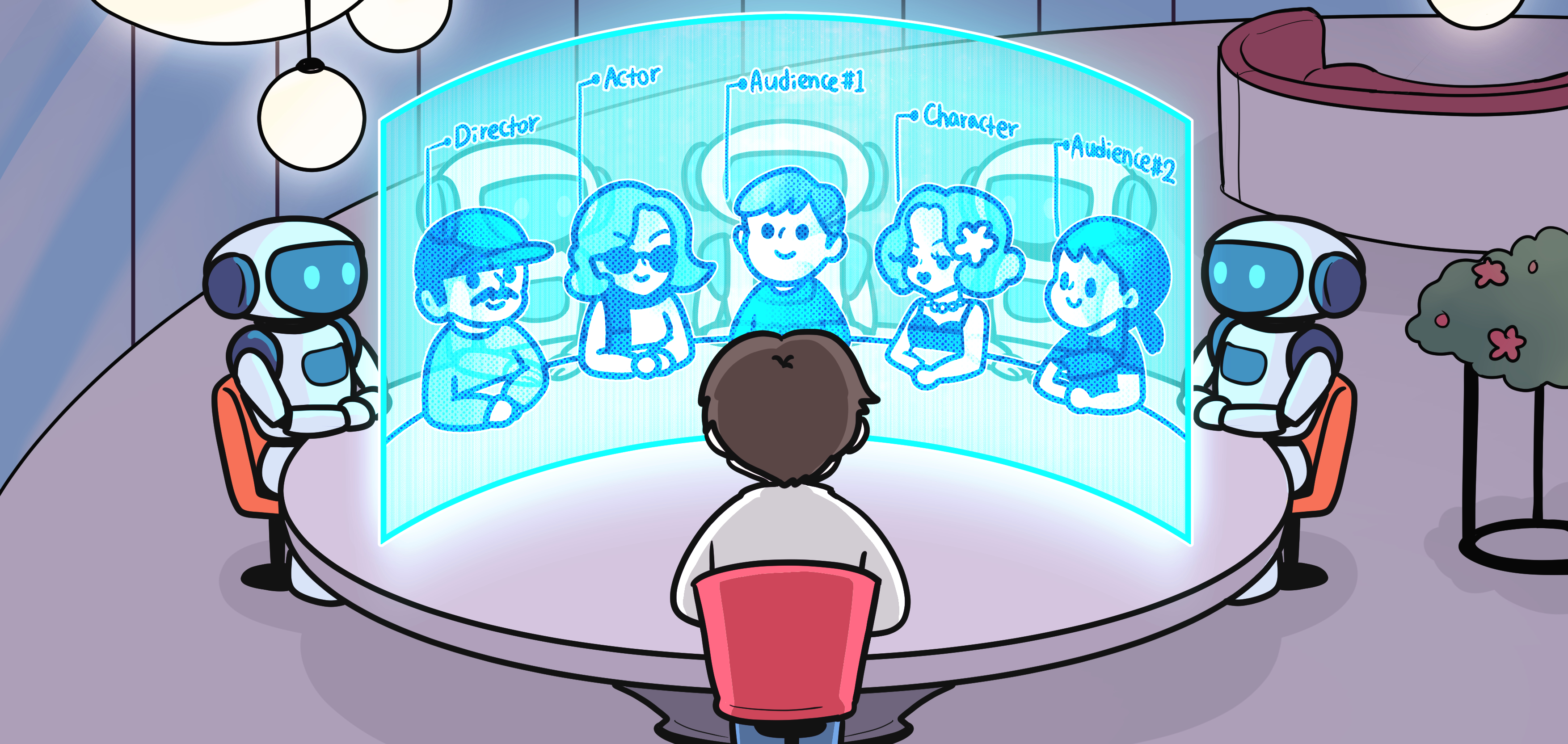
Cinema Multiverse Lounge

Multi-agent system where users converse with AI personas of directors, actors, and audiences for richer film appreciation.
Findings of ACL 2025

DICE-BENCH

Evaluating LLM tool-use capabilities in complex multi-round, multi-party dialogue scenarios.
CHI EA 2024

Chatbot Customization & Failure

How user-participated customization affects tolerance and recovery from chatbot failures.
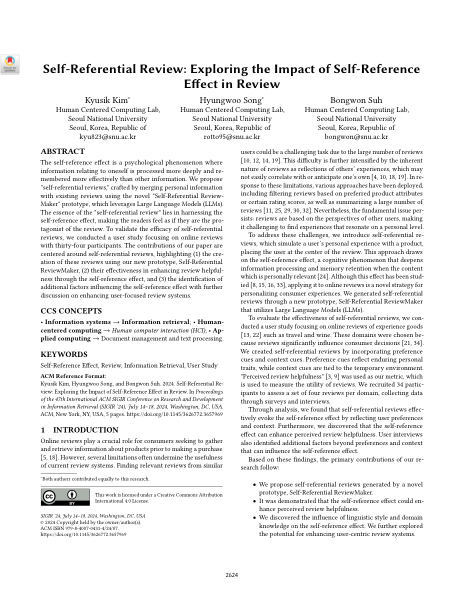
SIGIR 2024

Self-Referential Review

Exploring how self-reference effects influence review behavior and evaluation quality.
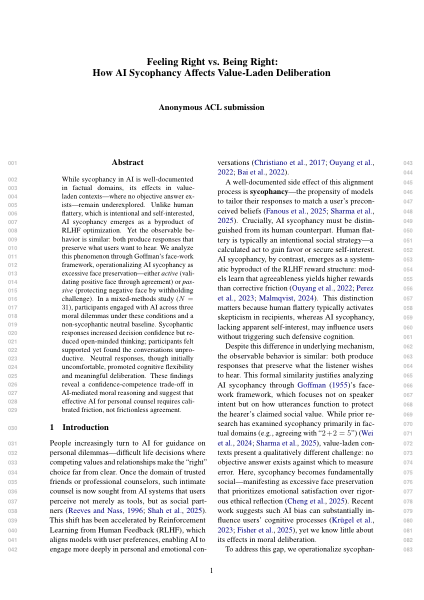
Designing these agents raised a deeper question: how should AI agents behave? This led to my work on Value Alignment.

Value Alignment

3 papers

To make AI truly serve people, it must reflect human values—not merely confirm biases. I study sycophancy in AI deliberation, selective exposure in argument search, and decision-making under pressure to understand how AI can support genuine reasoning rather than comfortable agreement.

ACL 2026

Feeling Right vs. Being Right

How AI sycophancy undermines value-laden deliberation—when AI agrees too readily, it erodes genuine moral reasoning.

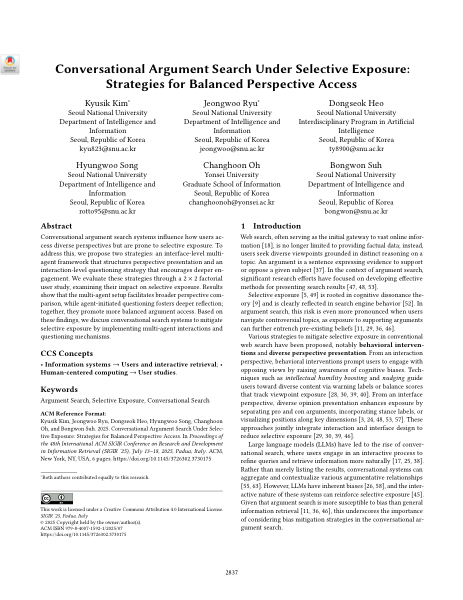
SIGIR 2025

Conversational Argument Search

Strategies to counteract selective exposure in argument search, enabling balanced access to diverse viewpoints.

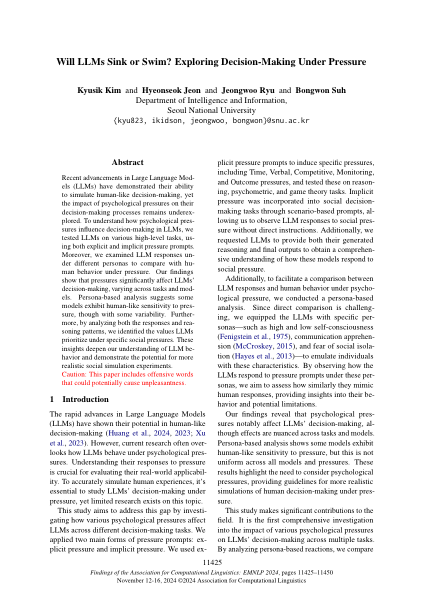
Findings of EMNLP 2024

Will LLMs Sink or Swim?

Exploring how LLMs make decisions under pressure, revealing systematic biases in high-stakes scenarios.

Values alone aren't enough—we also need to identify what can go wrong. This led to my investigation of biases in AI systems.

Fairness & Bias

5 papers

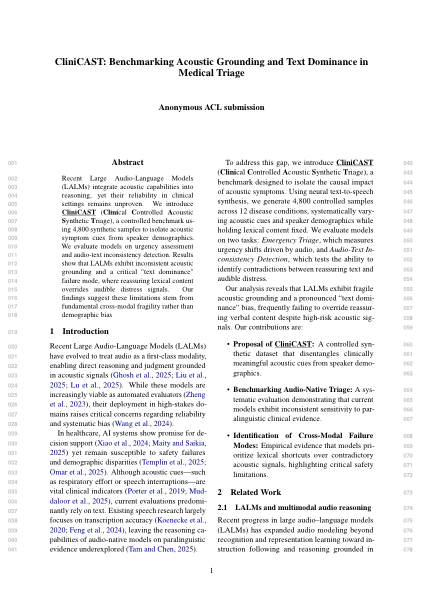
AI systems inherit and amplify human biases in subtle, often cross-modal ways. I investigate halo effects in AI hiring, visual interference in speech evaluation, gender matching biases, and acoustic grounding failures in medical triage—uncovering where bias operates so we can build fairer systems.

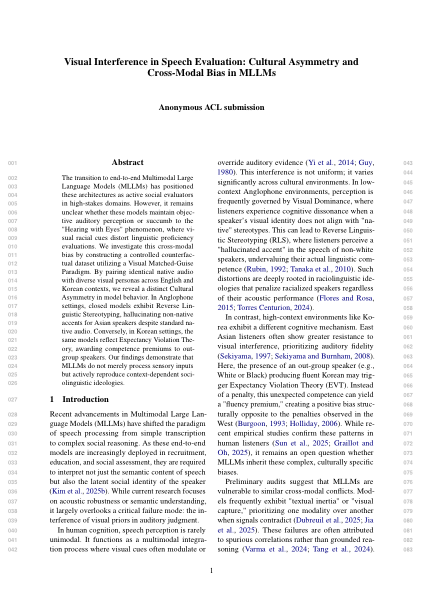
Findings of ACL 2026

Hearing with Eyes

MLLMs exhibit "Hearing with Eyes"—visual cues about a speaker's race interfere with speech evaluation, with culturally asymmetric patterns between Korean and English contexts.

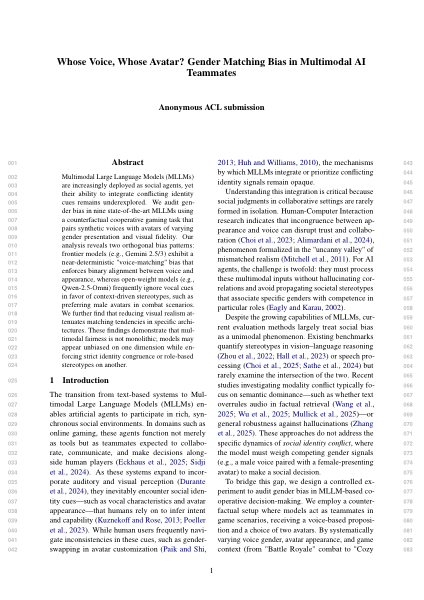
Findings of ACL 2026

Voice-Avatar Gender Conflict

In cooperative gaming, when an AI teammate's voice gender doesn't match its avatar appearance, MLLMs exhibit gender-congruence bias—favoring stereotypical voice-avatar pairings.

Findings of ACL 2026

Clinical Audio Bias

LALMs fail to ground acoustic symptoms (coughing, breathing patterns) in medical triage, over-relying on text content—a critical "text dominance" failure mode in healthcare AI.

SIGIR 2026

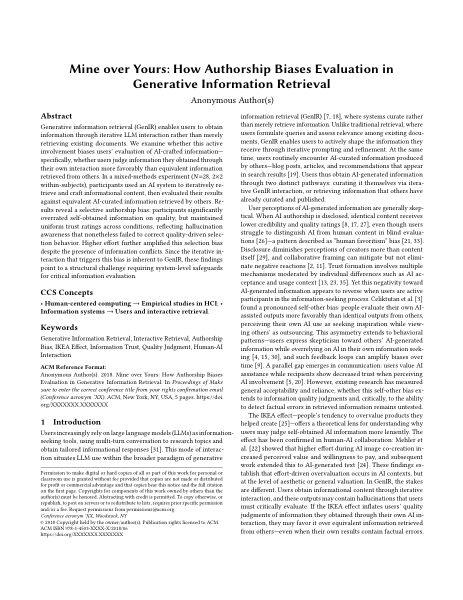
Mine over Yours: Authorship Bias

How authorship biases evaluation in generative IR—people favor their own generated content.

Findings of ACL 2025

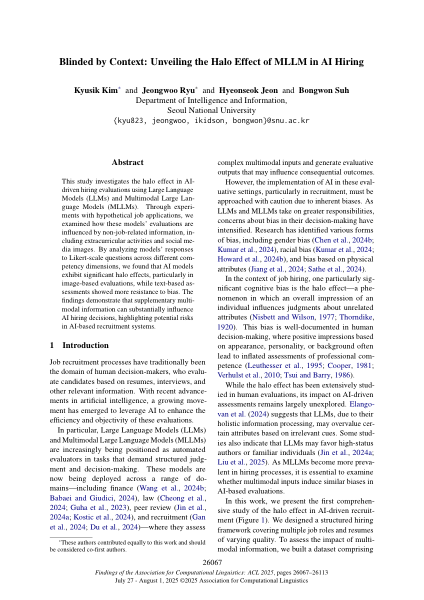
Blinded by Context: Halo Effect in AI Hiring

Contextual cues create halo effects in MLLM-based hiring, biasing candidate evaluation regardless of qualifications.

Building aligned, fair AI agents leads to the next question: can we simulate human-like agents at scale to test these properties—and what happens when simulation meets HAI?

Social Simulation

Current & Future

My current postdoc research brings all these threads together. If we can build agents that are aligned, fair, and human-like, we can simulate social systems at scale—testing policy communication, modeling social polarization, and understanding collective behavior. And when simulation meets HAI, we get AI systems that truly understand people.

Postdoc Project 2025–2026

Toward Mitigating Social Polarization in Korea

Building social conflict simulation and policy feedback systems using LLM-based agents. Constructing a Korean agent library (200+ agents) and validating polarization representation through debate simulations.

This is where my research is heading: human-centered AI systems informed by simulation, where aligned and fair agents interact with real people to create better social outcomes.

Foundations

Earlier work

My earlier work in graph neural networks built the technical foundations for my research career, though it follows a separate trajectory from my current HCI and AI alignment focus.

DASFAA 2024

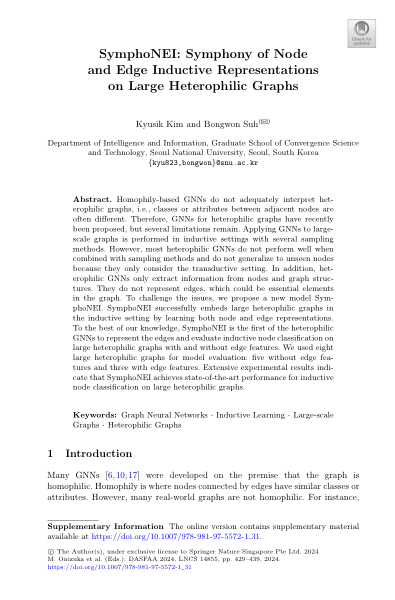
SymphoNEI

Combining node and edge inductive representations for learning on large heterophilic graphs.

DASFAA 2024

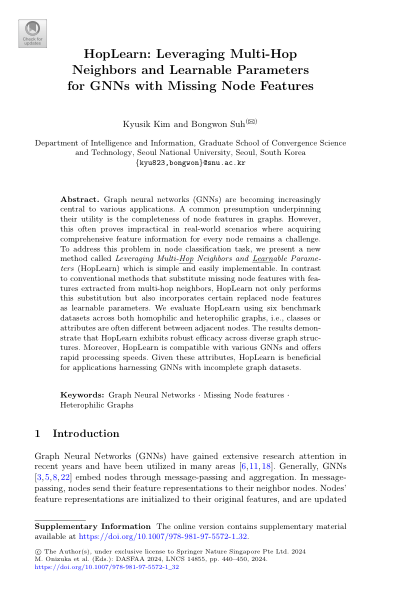
HopLearn

Leveraging multi-hop neighbors and learnable parameters for GNNs with missing node features.